Sam

Carmen Fanzone: Renaissance Man

In Uncategorized on July 4, 2011 at 3:53 pm

In the early 1970s the Cubs had a utility infielder by the name of Carmen Fanzone. Fanzone bounced around the Red Sox farm system for several years before making the big league club in 1970 but he was traded to the Cubs prior to the 1971 season. Plagued by injuries Fanzone never realized the potential he showed as a young player coming out of Detroit in the early 1960s and he was out of baseball by 1974.

The interesting thing about Fanzone was his off-season avocation: professional trumpet player. Fanzone played in Jazz clubs in Chicago, gave lessons and at one point was even a member of the Tonight Show orchestra. On road trips with the Cubs, while most of the other players were out on the town, Fanzone would be holed up in his room playing scales on his trumpet.

When I think about Carmen Fanzone I think about some of the other uniquely well-rounded and talented ballplayers of his era including Curt Flood, an accomplished painter or Denny McClain, an organist who was good enough to record two albums with Capitol Records. Reggie Smith, an all-star outfielder with a host of teams, was proficient on several instruments including, the cello, violin, clarinet and saxophone. On the road with the Red Sox or Cardinals, Smith would often forgo the bars for the art galleries. Steve Stone was a state–wide championship bowler and ping-pong player. And the list goes on and on….

Well-rounded ballplayers like Fanzone just don’t exist anymore for the simple reason that society nowadays attaches value to and amply rewards rigid specialization. Athletes are not immune and it is rare now to hear of a professional baseball player who can do anything well but play baseball. We seldom learn interesting details about a player – simply because there are none to tell. We have only statistics.

It was a better game when Carmen Fanzone played.

Happy 4th of July
Why yesterday’s players were better

In Uncategorized on June 15, 2011 at 12:12 am

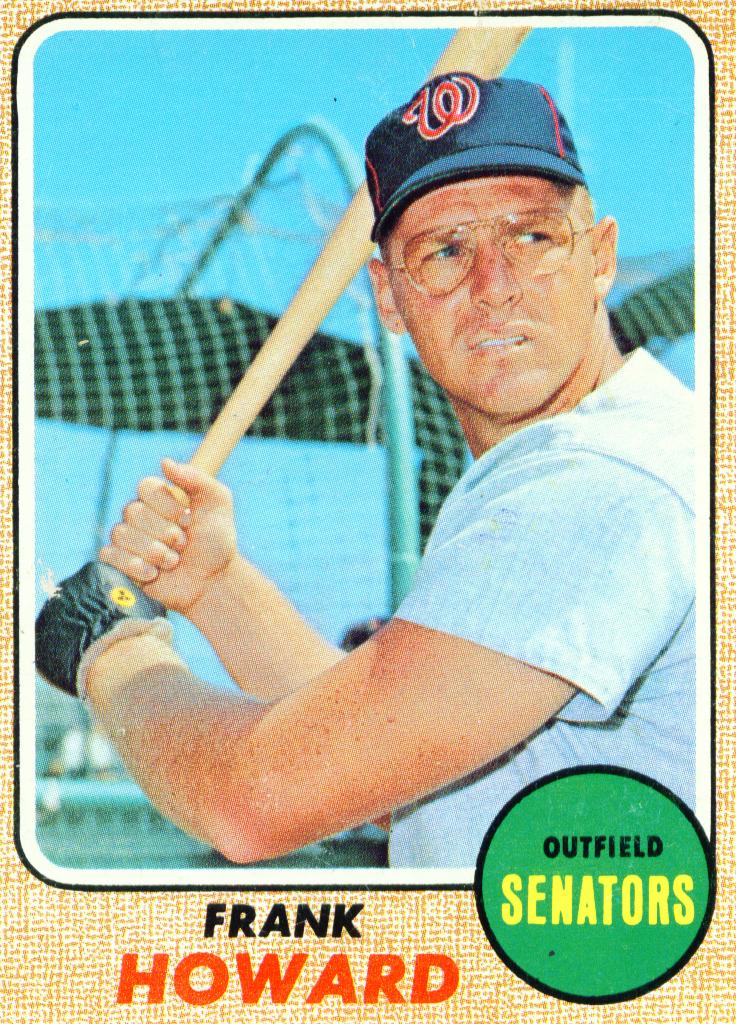
I don’t know how many times I have gotten into arguments with people who insist that professional baseball players nowadays are stronger, faster and overall better athletes than ballplayers of an earlier era. Even experienced broadcasters and analysts adhere to this belief. The facts however just don’t support this mis-guided point of view. A case in point: in the history of Tiger Stadium from 1912-1999 only four players hit the ball over the left-field roof: Frank Howard, Harmon Killebrew, Cecil Fielder and Mark McGwire. McGwire’s scandalous record speaks for itself. Although Cecil Fielder’s name has never been linked to steroids he did play in an era which was defined by steroid use and it would not, therefore, be unreasonable to suspect that he may also have used steroids at some point. Frank Howard and Harmon Killebrew, on the other hand, played when performance enhancing drugs were non-existent in American professional sports, and one could argue that they are the only two players who legitimately hit the ball out of Tiger Stadium in its 97 year history.

Similarly only three players have managed to hit the ball completely out of Dodger Stadium: Mike Piazza , Mark McGwire and Willie Stargell who in fact did it twice. Only Stargell’s and McGwire’s drives left the park on the fly. Piazza’s HR hit the roof in left field and bounced into the parking lot. Once again, McGwire’s record speaks for itself. Was Piazza’s home-run legitimate ? Probably not, for he also has long been suspected of using steroids. Willie Stargell on steroids ? Forget it.

In fact, if you google the older ballparks and the longest HRs in those parks, you will see that the longest HRs were hit by players going back one or two generations e.g. a Ted Williams HR at Fenway in 1946 that was measured at 502 ft – regarded as the longest ever HR at Fenway – or a Dave Kingman shot at Wrigley Field in 1976 which almost hit the scoreboard. In the history of Shea Stadium 1964-2007 only one player ever hit a ball into the third deck in LF. That was Tommie Agee in April of 1969. Not even Mark McGwire on steroids could accomplish that.

If today’s players are better athletes then why don’t they hit the ball as far as players in the “old” days ?

The answer: they can’t.

Baseball’s most exciting play: Play at the plate

In Uncategorized on May 27, 2011 at 5:15 pm

The headlines this week were about Buster Posey’s season-ending injury during the Giants–Marlins game the other night. Because of Posey’s increasing stature in the league – he is one of the NL’s upcoming stars – his is an injury that has generated much discussion. Many people are advocating that baseball change the rules to prevent violent collisions such as occurred Tuesday night. I have no doubt that Bud Selig will give in to these voices of change and at some point – maybe next season – there will be a rule change. And then one of baseball’s most exciting plays – the play at the plate – will be as non-existent as waxed Coke cups with cellophane lids.

In spite of its reputation as a non-contact sport, Baseball has always been a dangerous game. In the dead-ball era two players died after being beaned in the head by pitched balls and a player like Ty Cobb would routinely sharpen his spikes to intimidate the opposition when stealing a base. Although brushbuck pitches were a routine part of the game up until the 1980s batting helmets were not widely used until the 1960s and were not made mandatory until 1971. Yet even with the protection of a helmet there is probably nothing more fearful in sports than standing 60’ 6” away from a pitcher who is hurling a baseball 90 MPH at you – sometimes within inches of your head. In a sense, baseball is a lethal game on every play. But that is the beauty of baseball. It is a non-contact, finesse sport that requires a lot of guts.

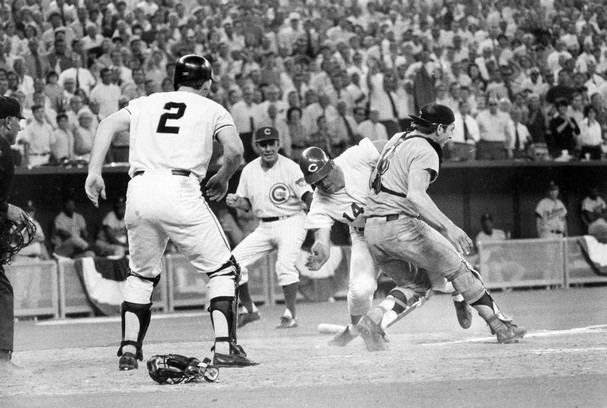
Participant in baseball’s most famous home plate collision – during the 1970 All-Star game in Cincinnati – Ray Fosse does not think the rules should be changed to protect the catcher. Asked to comment in the wake of the Posey injury, Fosse said that the sometimes violent confrontation between catcher and base-runner cannot be avoided and that tradition should be respected – even though his own promising career may have been shortened by his collision with Rose. I could not agree more. The image of Rose racing down the third-base line and barreling into Fosse to score the winning run in the bottom of the 12th inning is perhaps the most enduring and exciting moment in All-Star game history.

So with the collision in San Francisco the other night. It is unfortunate that Posey was injured and will likely miss the remainder of the season. But it was exciting baseball.

Baseball at its best.

Design a site like this with WordPress.com
Get started